For operators
Keep your own record.
A continuous view of how your fleet is behaving, with the record already there when something goes wrong.
The runtime data recorder for autonomous robot fleets
Roboblackbox continuously records what the fleet publishes, giving operators a factual view of observed fleet behavior and preserving the same independent record for software changes, incidents, claims, and underwriting.
Raw fleet data stays on site · No software on the robots · No control path
Day to day
The same continuous record gives operators a factual view of observed fleet behavior over time, and a way to see when an event becomes a pattern.
A single event tells you what happened once. The fleet report tells you whether it is becoming a pattern.
How it works
A small, fanless appliance installed at the operator's site. It listens to the network the robot fleet already uses and records what the fleet publishes as it runs. The captured record is sealed as it arrives, so any later change is detectable.
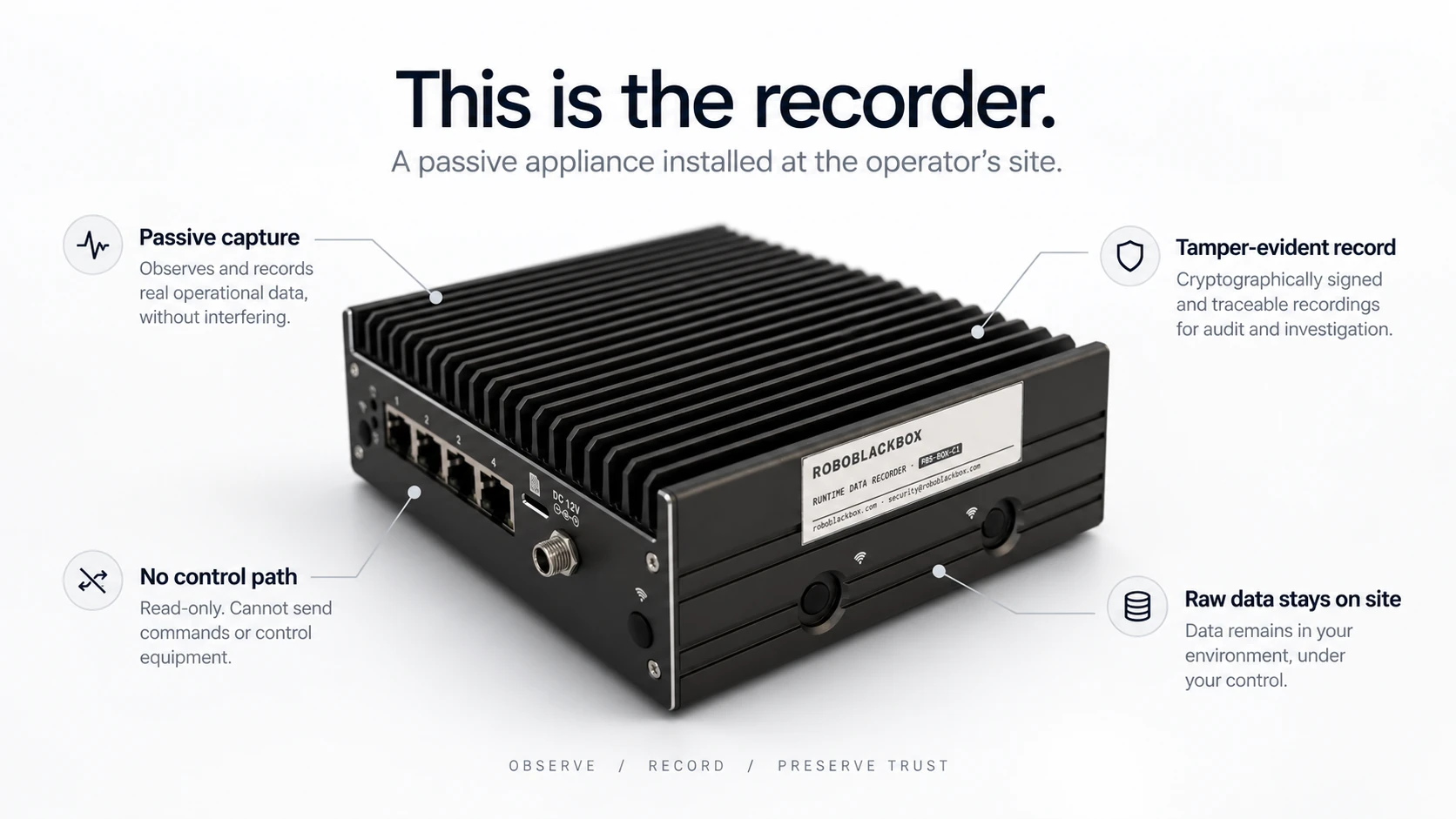
The box is not the product. The independent record is.
Nothing is installed on the robots and nothing is sent to them.
Raw fleet telemetry stays on site unless the operator chooses to export it.
What the fleet publishes
Passive, on-site recording
Sealed source messages
Findings trace back to source
After a change
Robot fleets do not stay fixed after deployment. When software changes, operating rules change, or the operator makes a fix, the same continuous record shows what observable behavior followed.
Measure what changed instead of arguing about it.
Note that before/after association is not proof of causation.
After an incident
Event: "On a Tuesday afternoon, a robot in aisle 7 came within half a metre of a worker and stopped. Nobody was hurt."
The floor leadwants to know why it got that close.
The insurerwants to know how often that happens.
The vendorsays the last update changed nothing.
All three could use the same Roboblackbox record.
Select the relevant window and reconstruct what the fleet published, in order, with capture scope, clock statements, completeness, and limitations stated alongside it.
The report only describes what the record shows. It does not determine fault, assess risk, or recommend action.
Evidence & provenance
Roboblackbox preserves the source record before deriving findings from it. A finding can point back to the sealed messages it came from, and the evidence package can be checked offline with the verifier we ship alongside it.
Record first. Interpret second.
We separate what was observed from what was inferred.
Tamper-evidence proves that the captured record was not altered, but it cannot prove that the robot told the truth.
If a signal was not published, traffic was missed, or clocks were skewed, we cannot fix it, but we record the gaps and inconsistencies.
Insurance
Before a loss, the record supports underwriting. After a loss, it supports claims.
The same continuous record provides operational context for renewal, loss-control review, claims investigation, and subrogation.
We report behaviour; carriers set rates.
Independent runtime evidence for underwriting, renewal, loss-control review, claims, and subrogation.
We are looking to start with autonomous robot fleets that are operating in warehouses, factories, and logistics sites.
Work with us
We are looking to work with insurance teams and robot operators, to determine which observable behaviors actually change an operational, underwriting, or claims decision.
For operators
A continuous view of how your fleet is behaving, with the record already there when something goes wrong.
For insurance teams
Explore the evidence and report format with us for underwriting, renewal, and claims decisions.