Operators, integrators & safety teams
Help evaluate the record.
Explore supported sources, recording scope, evidence methodology, and the limits of operational review.
The independent record for robotic operations.
Roboblackbox brings together what robots publish, what facility systems report, what cameras observe, and what operators declare. One independent record, controlled by the operator, for reviewing behavior, investigating changes, and examining incidents, with each source and its limitations kept visible.
Many sources. One independent record.
Raw data stays on site · No software on robots · No control path
Five source types
Robotic operations involve more than robots. Roboblackbox brings together information from the systems operating at a site, preserving where each observation came from, when it was recorded, and what it can and cannot establish.
Each source keeps its identity. Each observation keeps its limits.
Day to day
A single event gives you one observation. A continuous record helps you examine whether similar events recur, where they occur, and what changed around them. Review reported robot behavior alongside available facility states, camera-derived observations, and the operator’s declared rules. Look for patterns across equipment, locations, operating conditions, and software changes.
These questions guide review of the available evidence; the record does not guarantee an answer.
How it works
Roboblackbox sits alongside the systems already operating at your site. It records available robot publications, and its read-only integrations are designed to bring in facility states and observations derived from on-site cameras.
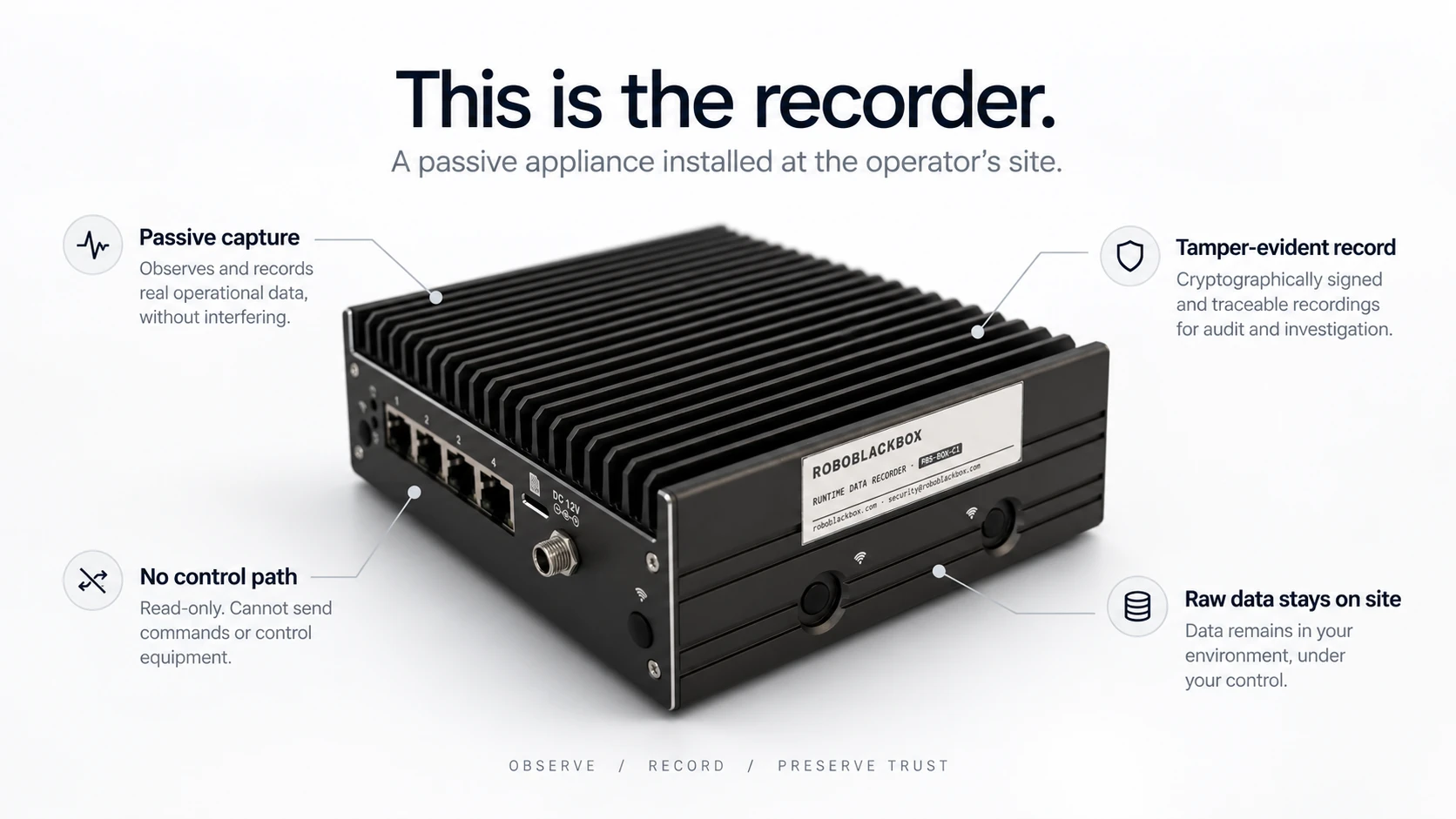
The box is not the product. The independent record is.
The operator defines the recording scope and declares the rules and changes that provide context for review. The multi-source architecture preserves source attribution, timestamps, and evidence-integrity information.
Nothing is installed on the robots and nothing is sent to them. Roboblackbox does not command robots, replace safety systems, or determine whether an operation is safe.
Establish authorized read-only access to supported robot and facility sources.
Preserve published states, attributed observations, and operator declarations within the supported scope.
Examine events and changes while keeping source disagreements, missing information, and limitations visible.
Check integrity and provenance using available checks. Integrity checks do not establish source truth.
After a change
Robot fleets do not stay fixed after deployment. When software changes, operating rules change, or the operator makes a fix, the same continuous record shows what observable behavior followed.
Measure what changed instead of arguing about it.
Note that before/after association is not proof of causation.
After an incident
Illustrative multi-source investigation: a robot stops near a pedestrian crossing.
Robot publicationsreport motion and operating state.
Camera and facility sourcesCameras provide video-derived observations of nearby activity. Facility systems report their available states.
Operator declarationsprovide context about the rules in force.
Investigators can examine what each source reported, where their accounts agree, and where information is missing.
Within the configured recording scope, Roboblackbox brings the relevant records together for review. This illustrative example describes the multi-source investigation workflow.
The record preserves the evidence. People determine what it means. It does not determine fault, causation, responsibility, or safety.
Evidence & provenance
Roboblackbox is designed to preserve the distinction between what a system reported, what a camera-derived model estimated, and what an operator declared. Evidence should remain reviewable with its source, timestamp, applicable rules, uncertainty, and coverage limitations. Where sources disagree, the disagreement remains visible.
Record first. Interpret second.
Each source keeps its identity. Each observation keeps its limits.
A preserved record can be checked for integrity, but that does not establish that every reported value accurately represented physical reality.
Missing signals, capture gaps, clock differences, processing context, and uncertainty limit what the record can establish.
Insurance & claims
When authorized by the operator, preserved operational records can provide context for underwriting reviews and claims investigations.
Insurance professionals determine how recorded observations and their limitations are used. Access to operational records requires operator authorization.
We preserve operational evidence. Insurers make underwriting decisions.
Independent runtime evidence for underwriting, renewal, loss-control review, claims, and subrogation.
An operator-controlled record across vendors, software changes, and incidents.
Work with us
We welcome warehouse and factory operators, robotics integrators, and safety specialists interested in evaluating independent operational records. We’re looking for partners who can help evaluate read-only integrations, review our evidence methodology, and identify where an independent operational record would be useful. We also welcome insurance and claims professionals interested in reviewing the resulting evidence formats.
Operators, integrators & safety teams
Explore supported sources, recording scope, evidence methodology, and the limits of operational review.
Insurance & claims professionals
Examine how operator-authorized records could provide context for insurance and claims review.